Subterranean termites require continuous ground contact to maintain the moisture levels necessary for survival in Alabama red clay soils. In historic Birmingham neighborhoods such as Highland Park, Forest Park, and…
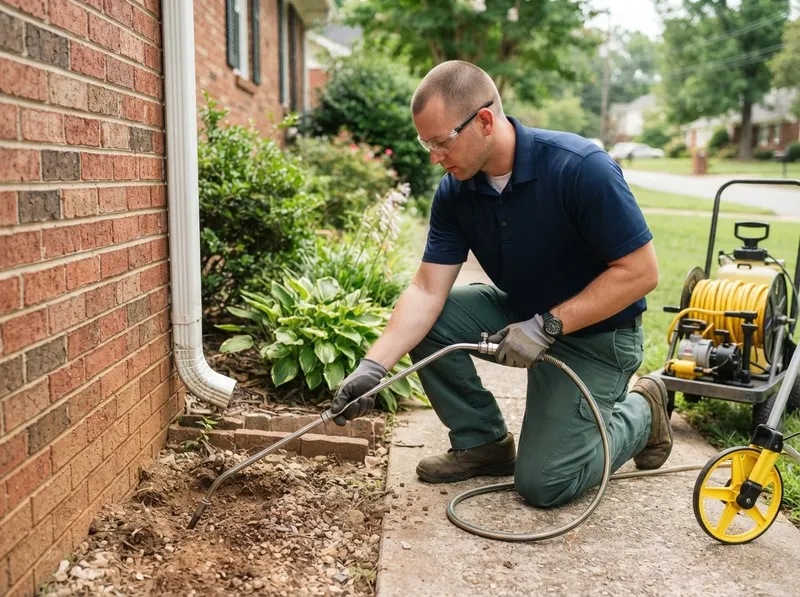
Subterranean termites require continuous ground contact to maintain the moisture levels necessary for survival in Alabama red clay soils. In historic Birmingham neighborhoods such as Highland Park, Forest Park, and Five Points South, older brick pier foundations and low crawl space clearances create dark, damp conditions where subterranean colonies construct vertical mud shelter tubes along masonry piers. Homes in Avondale, Crestline, and Norwood often feature attached concrete porches or slab patio expansions; these joints act as direct conduits from the soil to subfloor framing. Treatment requires continuous perimeter trenching 6 inches wide by 6 inches deep directly against exterior foundation walls, applying 4 gallons of non-repellent liquid termiticide per 10 linear feet into the backfill soil to saturate down to the footer.
Liquid non-repellent termiticide barrier application fits active infestations requiring immediate population collapse, whereas standalone perimeter bait stations fit structures where sub-slab utility lines prohibit deep drilling. The trade-off between the two approaches involves upfront drilling versus ongoing monitoring: liquid soil barriers provide an uninterrupted protective curtain that subterranean workers pass through blindly, transferring the active ingredient back to the subterranean nest through social grooming within 30 to 90 days. Conversely, exterior bait systems avoid drilling patio slabs in properties near Roebuck Springs or Huffman, but rely on subterranean foragers finding the cellulose matrix over several feeding cycles before colony suppression occurs.
Foundational construction dictates exact treatment mechanics across Jefferson County. Monolithic slab homes common in newer construction require horizontal perimeter barriers along the exterior stem wall, paired with precision 1/2-inch vertical drilling every 12 inches through attached garage slabs and tiled entryways. Elevated crawl space homes require dual-sided trenching: one trench along the exterior foundation perimeter and a separate interior trench around the crawl space footing and every interior brick pier. All treated drill holes are patched with structural hydraulic cement flush to the concrete surface. The operational standard avoids multi-year recurring contract lock-ins, focusing instead on dense, complete chemical barriers installed correctly on the initial application.
Every job gets a firm, written price after a free on-site visit.
Tell us about your subterranean termite treatment job in Birmingham and we'll send a clear, written quote, usually the same day.
 BugBouncer Pest Control